
Procurement teams running label, tape, and hygiene lines rarely get hurt by price alone. Trouble usually starts when a drum arrives with a different solids content than the previous shipment, or when a coating line stalls because of foam. Deciding where to place a waterbased acrylic pressure sensitive adhesive bulk purchase is therefore a technical question first and a commercial one second. The sections below map the plant conditions, chemistry checks, compliance files, and handling routines that separate a repeatable acrylic emulsion supply from one lucky batch.
Scale decides whether a supplier absorbs a seasonal spike without diluting quality. E Plus Chemical Co., Ltd, founded in 2012 in China, operates a plant of roughly 40,000 square metres with more than 60 research laboratories, and produces water-based acrylic adhesive under full DCS supervision. A distributed control system logs reactor temperature, feed rate, and initiator dosing for every batch, so a waterbased acrylic pressure sensitive adhesive bulk purchase can be traced to recorded process data instead of a verbal promise. Ask for reactor volume, monthly output, and how many batches sit behind a quoted tonnage. A trading house unable to answer those three questions is reselling someone else's emulsion.
Paperwork remains the lowest-cost risk control available. A credible producer supplies an SDS carrying the CAS number, hazard classification, and NFPA ratings, plus REACH registration status for European entry and ISO 9001 certification covering batch release. OSHA and EPA references matter once adhesive pails enter a coating room where operators handle open containers. Confirm the certificate of analysis format before ordering, and check which properties get reported: viscosity, pH, solids content, particle size, and residual monomer. Consistent reporting fields let incoming inspection compare shipments month after month rather than guess.
A European label converter running direct thermal facestock reported edge lifting on curved bottles after switching to a cheaper emulsion. Peel strength still met specification on steel panels, yet cohesion was too high for a soft substrate and coat weight had drifted. Laboratory review traced the failure to a copolymer with elevated glass transition temperature and unstable solids content. A reformulated grade with a softer acrylate monomer balance, verified at 12 g/m² dry coat weight, restored wet-out on low-surface-energy plastics. Complaint rates fell over the following quarter, and that converter consolidated its waterbased acrylic pressure sensitive adhesive bulk purchase into scheduled monthly deliveries.
Pressure sensitive adhesive behaviour is a controlled compromise. Free radical emulsion polymerization builds an acrylic polymer from soft monomers such as 2-ethylhexyl acrylate together with harder comonomers, while surfactant and initiator systems govern particle size and molecular weight distribution. Soft segments lower the glass transition temperature and raise tack; harder segments plus light crosslinking raise shear strength and cohesion. Push tack too far and the film splits, leaving residue on the substrate; push cohesion too far and the film refuses to wet rough surfaces. Grade selection inside a waterbased acrylic pressure sensitive adhesive bulk purchase starts from substrate type, service temperature, and target peel value.
2-Ethylhexyl acrylate, CAS 103-11-7, ships with a polymerization inhibitor such as MEHQ because acrylate monomer self-polymerizes under heat or peroxide contact. Low inhibitor grades with high purity and low volatility give the reactor a cleaner start and less gel, which is why monomer specification belongs inside every waterbased acrylic pressure sensitive adhesive bulk purchase discussion. Excess inhibitor slows conversion and leaves residual monomer that later affects odour and thermal stability. Weathering performance and UV resistance in the finished acrylic emulsion also trace back to feedstock quality, since degraded monomer yields a polymer that yellows and loses flexibility outdoors.
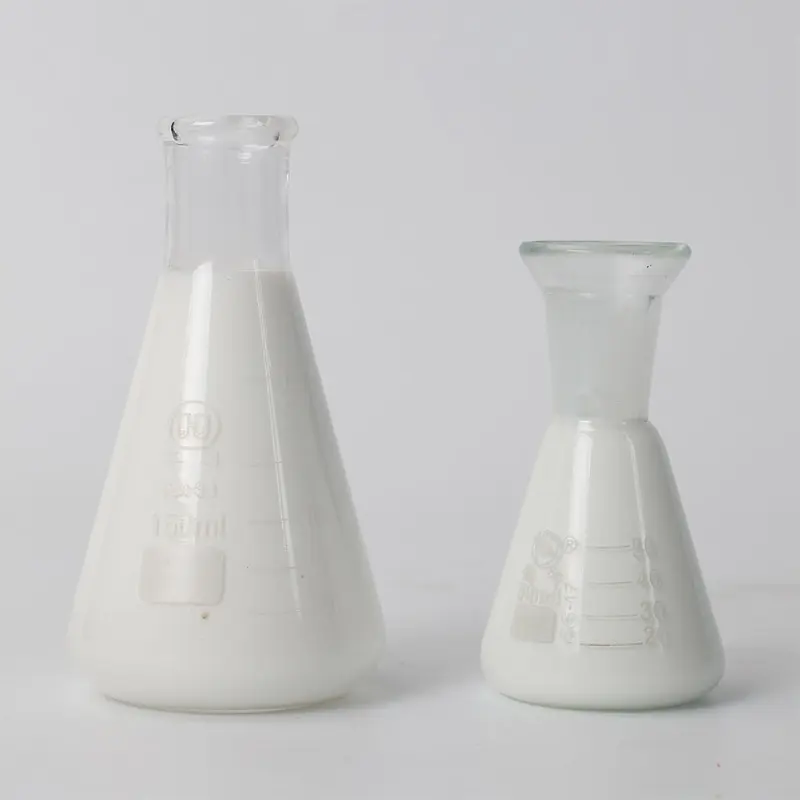
Waterborne systems carry risks that solvent grades never show. An acrylic emulsion is a colloid held apart by surfactant and pH; let the drum drop below freezing and irreversible coagulation appears as grit on the coating head. Store between 5 °C and 35 °C, away from direct sunlight, and keep containers sealed against skinning. pH drift toward the acid side reduces storage stability and thickens the latex, while prolonged heat shortens shelf life. Rotating stock on a first-in, first-out basis protects a waterbased acrylic pressure sensitive adhesive bulk purchase held for several weeks.
Sampling belongs before any drum set reaches production. Check viscosity at a fixed temperature and shear rate, solids content by oven method, pH, and appearance against the certificate of analysis. Retain a sealed sample from every lot for at least the stated shelf life so a later dispute has physical evidence. Trial coating on the real substrate, followed by peel strength and shear strength testing after 24 hours of dwell, catches problems that laboratory numbers hide. Flush transfer pumps and lines between grades to avoid cross-contamination and coagulum.
A dependable source shows itself through evidence: DCS batch records, ISO 9001 release control, REACH and SDS documentation, and a laboratory able to explain tack, cohesion, and glass transition trade-offs for one specific substrate. E Plus Chemical Co., Ltd combines 2-ethylhexyl acrylate expertise, acrylic waterborne resin emulsion capability, OEM service, and VOC reduction experience across labels, tapes, packaging, hygiene, medical, automotive, and construction work. Treat a waterbased acrylic pressure sensitive adhesive bulk purchase as a qualification project — audit the plant, test the grade, fix the storage routine — and supply becomes predictable rather than seasonal.
A complete package includes the SDS with CAS number and NFPA data, a certificate of analysis listing viscosity, pH, solids content and particle size, the ISO 9001 scope, and REACH status for European entry. Transport paperwork plus batch identification allow traceability back to reactor logs. Generic or missing documentation usually signals a repackager rather than a producer holding real process control.
An emulsion stays stable because surfactant and pH keep polymer particles dispersed. Freezing forces those particles together and creates irreversible coagulation, visible as grit or filter blockage. Sustained heat accelerates hydrolysis, thickens the latex, and shortens shelf life. Holding drums between 5 and 35 degrees Celsius, sealed and shaded, preserves storage stability and coating consistency throughout the stated shelf life.
MEHQ prevents unwanted polymerization during transport and storage of the acrylate monomer. Low inhibitor, high purity grades let the reactor reach controlled conversion with less gel and fewer specks, supporting stable molecular weight. Excess inhibitor delays initiation and can leave residual monomer that affects odour and thermal stability. Monomer purity therefore shapes peel strength and weathering behaviour in the finished polymer.
Viscosity at a fixed temperature, solids content by oven drying, pH, and particle size form the routine incoming set. A trial coating on the production substrate, then peel strength, tack, and shear strength measurement after a standard dwell, confirms application behaviour. Comparing results against a retained sample from the earlier lot exposes drift before a full production run starts.
Manufacturers with dedicated laboratories adjust monomer ratio, solids content, and crosslinking level to a converter's line speed and substrate. E Plus Chemical Co., Ltd runs more than 60 research laboratories and offers OEM development alongside a waterbased acrylic pressure sensitive adhesive bulk purchase, including trial batches, coating evaluation, and documentation support for REACH and VOC reduction targets in export markets.
 EN
EN