
What an acrylate resin sample actually tells you
Securing an acrylate resin sample before any large commitment is the most reliable way to reduce formulation risk. A small, representative quantity lets a buyer observe viscosity, particle size, and film formation under real lab conditions instead of trusting a datasheet alone.
The value of an acrylate resin sample goes beyond a quick check of appearance. It reveals thermal stability, shear response, and how the polymer interacts with pigments and fillers already in use. Those details decide whether a grade will survive a customer's process or fail on the line.
Skipping trial formulation to save a few days often backfires. A coating line that looks fine in a supplier's demo can streak, crater, or lose adhesion once scaled to full width. Reworking a failed batch burns raw material, machine time, and the trust of downstream customers. Requesting an acrylate resin sample costs little but exposes a mismatch early, when it is still cheap to fix.
A structured sample policy turns that gamble into a measured step. By defining what to test and how to pass, buyers avoid repeating the same expensive mistakes with every new grade they evaluate. The few days saved by skipping the step are rarely worth a scrapped production run that a proper formulation trial would have caught.
A mid-size adhesive producer needed a softer, low-temperature-flexible bond for freezer packaging. Their existing supplier could not meet the spec, so they shortlisted an acrylate emulsion built on catalytic polymerization with 2-EHA as a key monomer. The team was under pressure to launch before the holiday peak and had little room for error.
They requested a free acrylate resin sample and ran a bench test against three candidate grades. Compatibility with the current defoamer and thickener was checked first, then an application test on the actual liner. One grade yellowed under UV; another lost peel strength after aging. The surviving grade moved into a pilot run on one production cell.
Within two weeks the line hit target bond strength and the launch shipped on time. The careful evaluation protocol prevented a recall that a blind bulk order would have triggered. Performance validation across the pilot gave the team confidence to scale without a surprise.
An acrylate resin sample earns trust only through repeated, documented checks. The protocol below separates early screening from plant proof.
Start compatibility work on a small scale. Mix the sample with every additive already in the recipe and watch for flocculation, viscosity drift, or seediness over 48 hours. A bench test should measure dry time, gloss, and early water resistance for a coating, or open time and tack for an adhesive. Reference ASTM methods for adhesion, cure, and chemical resistance so results compare with industry norms.
Record results against the technical datasheet so deviations are visible. This stage is cheap insurance before any material reaches a customer-facing process.
Move to an application test only after bench results look stable. Run the sample on the real substrate with the real spray or roll coater, not a lab idler. Then scale to a pilot run limited to one cell or one shift. Performance validation at this stage confirms that lab promise survives plant reality.
Keep the evaluation protocol written and shared with the supplier so findings are reproducible and auditable under ISO 9001 documentation practice.
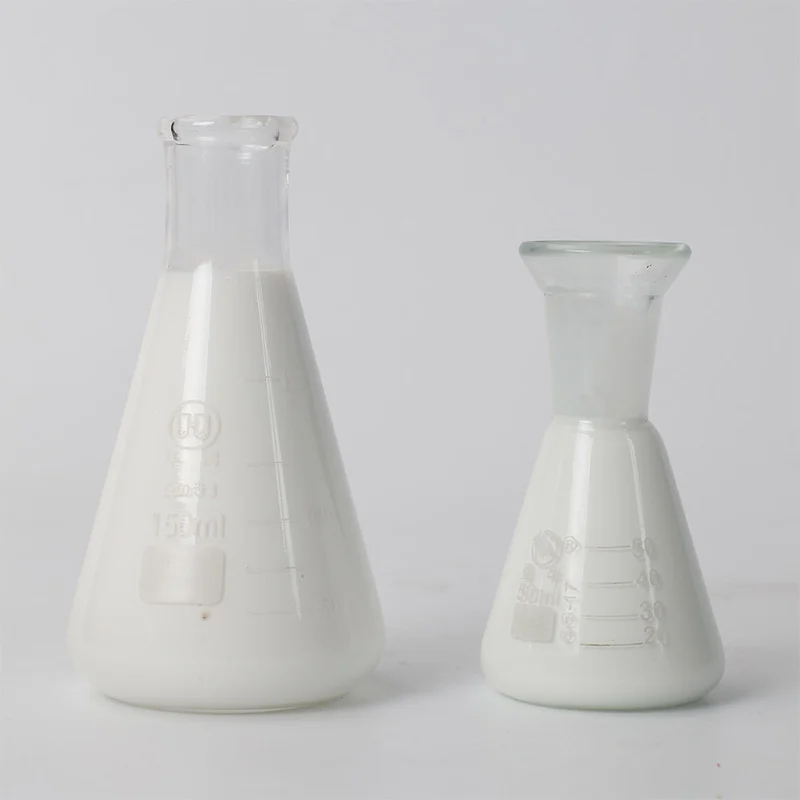
Before ordering, compare the technical datasheet with the sample results and flag any gap. Confirm lead time and MOQ with the manufacturer, since a grade that fits the lab but ships too late or in too large a lot creates its own risk.
For a 240,000 t/yr producer using catalytic polymerization and OEM customization, grade flexibility is real but still needs documented sign-off. Treat the acrylate resin sample as the baseline that every later purchasing decision references. Strong technical support helps interpret borderline numbers before a commitment is made.
Once received, store the sample and the bulk lot under the same conditions. Track performance validation across batches by keeping a simple log of viscosity, pH, and film properties. Re-test when storage temperature drifts or when a monomer like 2-EHA feed changes. Good technical support from the supplier helps interpret drift and adjust the recipe before a problem reaches the customer.
Routine lab evaluation turns a one-time sample into a lasting quality control habit. Pair the log with the original technical datasheet so future buyers see the full history. This discipline protects both the product and the relationship with the supplier.
Building this habit also sharpens future formulation trial planning. A clean bench test record plus the original technical datasheet lets a new pilot run start from evidence instead of guesswork, so compatibility questions get answered before the next purchase.
A disciplined acrylate resin sample program protects margin and reputation at the same time. By pairing a clear sample policy with bench and application testing, buyers match the right grade before committing volume. The result is fewer surprises, steadier quality, and a stronger working relationship built on evidence rather than assumption.
Question: What does a sample evaluation protocol typically include? Answer: A sound evaluation protocol covers compatibility screening, bench testing, application testing, and a defined pilot run. It lists the target properties, the test methods, and the pass or fail criteria agreed with the supplier. Documenting each step keeps results reproducible and supports quality records. A written protocol also helps different team members repeat the work and compare grades on equal terms.
Question: Why is compatibility testing important before a bulk order? Answer: Compatibility testing shows whether the new material mixes cleanly with existing additives, pigments, and thickeners. Poor compatibility causes flocculation, viscosity drift, or weak adhesion that may not appear until production scale. Catching these issues at sample stage avoids scrapped batches and customer complaints. A failed bulk order is far costlier than a careful lab check, so this step protects both margin and delivery schedules.
Question: How long does a typical formulation trial take from sample to pilot run? Answer: A typical trial moves through several stages. Compatibility and bench work often take one to two weeks, depending on cure cycles and test load. An application test adds a few days on the real substrate. A limited pilot run may need another one to two weeks for aging and validation. Total lead time varies with grade complexity, but most programs reach a decision within four to six weeks.
Question: Can a free sample represent the full production batch quality? Answer: A free acrylate resin sample is normally drawn from the same production line and process used for full orders, so it reflects typical batch quality. Variation still exists between lots, which is why performance validation across deliveries matters. Request the technical datasheet and compare sample results to it. If the sample matches documented specs and the pilot run holds, confidence in the bulk lot increases.
Question: Where should a resin sample be stored before testing? Answer: Store the sample under the same temperature and light conditions planned for the bulk material. Keep containers sealed and labeled with receipt date, lot number, and expiry if given. Avoid freezing or prolonged heat, which can alter particle stability and film properties. A consistent storage routine ensures test results reflect the product, not the environment, and makes findings comparable across batches.
 EN
EN